


According to the international classification of diseases, osteochondrosis of the lumbar spine belongs to the tenth group (ICD 10).This disease is one of the most frequently diagnosed spine disorders.

Changes and complications in the course of the disease lead to the formation of intervertebral hernias, severe pain and dysfunction of the intervertebral discs.
This disease is recorded in 80% of patients who seek help for lower back pain.As a rule, osteochondrosis occurs in old age due to:
- increased loads during life in relation to the lower back,
- lime salt deposits,
- age changes.
Description and symptoms of the disease
Characteristic signs of lumbar pathology include the following manifestations:
- reduced flexibility and mobility;
- difficulty turning, rotating, tilting the body;
- general fatigue;
- sleep disorders;
- difficulty in fulfilling natural needs and self-care due to pain;
- irritability, sudden sweating;
- coldness or tingling in the legs;
- spasmodic manifestations in the arteries of the feet;
- disorder of sexual function (in men), menstrual cycle (in women);
- varicose veins.
In fact, the question of what is osteochondrosis of the lumbar spine can be answered with the following theses:
- Reduction of the distance between the intervertebral discs, impairment of their functionality, loss of moisture and elasticity.
- Overstrain and chronic weakness of the spinal muscles.
- Impaired ability to absorb shock of discs, their partial deformation and impact on nerve endings that lead to pain (refers to the 3rd and 4th stages of the disease).
The course of the disease
The development of the pathology takes place gradually.It is customary to distinguish 4 stages of medical history:
- The first degree is manifested by local pain in the lumbar region, which is intensified by physical activity.This symptom signals that the muscles are overstrained and that the process of deformation of the intervertebral discs has already begun.Also, patients at this stage can feel a dull pain in the back, which spreads to the gluteal region, burning, stinging.As a rule, pain occurs after carrying heavy objects or sudden movements.
- Period 2 of the disease is characterized by the beginning of the deformation of the surrounding tissues, the fibrous ring of the disc and the reduction of the natural distance between the vertebrae.Compression (squeezing) of nerve roots also develops.At this stage, the patient may feel a sharp pain that progresses while walking.There may be a tingling or cold feeling in the legs.Disc protrusion and bulging develop.If a painful attack occurs, the patient mechanically deviates in the opposite direction from the source of the pain syndrome.
- The third stage is characterized by the final destruction of disc rings and the appearance of intervertebral hernias.Pain in the lower back becomes more frequent and stronger, radiating to the legs and back, regardless of load and movement.
- The fourth stage of osteochondrosis is characterized by abnormal growth of the vertebrae.Cartilage goes through significant atrophic processes.The pain may subside, indicating the formation of protective tissue, but this in no way serves as a sign of recovery.The disease in this phase most often leads to the patient's disability.
Concomitant diseases
Almost identical manifestations of the disease in question are characterized by deforming spondylosis of the corresponding part of the body.This disease belongs to the late stages of osteochondrosis and has the following symptoms:
- a feeling of heaviness in the back, especially in the lower part;
- acute pain in a sitting position, when moving;
- pain in the lower back when bending, stretching and other movements.
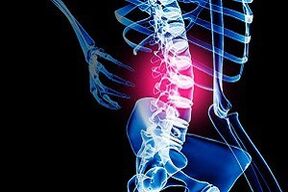
This disease is characterized by dramatic changes in the vertebrae with the formation of bony growths that irritate the ligaments of the spine.Growths (osteophytes) can reach significant sizes, cause fusion of parts of adjacent vertebrae and put pressure on nerve roots.
The consequences of the disease, in addition to pain, can also be reduced mobility, discomfort when the weather changes, and disability.
The disease mainly develops in old age due to excessive load on the lumbar part and the deposition of lime salts.In young people, spondylosis can develop due to the curvature of the spine and improper distribution of the load on the back muscles.
Health gymnastics, physiotherapy and medical procedures
It is impossible to completely cure the disease.The first two stages of health problems with the spine can be cured quickly and for a long time.In addition to drug therapy, which is prescribed by a doctor after an appropriate examination, patients are shown physical procedures and equipment for practicing osteochondrosis of the lumbar spine.
This includes:
- massage - can reduce pain, strengthen the muscles of the lumbar region and relax problem areas.
- Physical activity, exercises to strengthen the back muscles.
- Amplipulse, the effect of magnetic resonance.
- Iontophoresis and diadynamic currents.
The optimal result in the treatment of osteochondrosis of the lumbar spine is achieved with an integrated approach using traditional therapy, massage, physiotherapy and traditional medicine.For preventive purposes, you should strengthen your back muscles, do not avoid physical activity and follow a proper diet.Also, do not forget about the timely treatment of other back diseases and maintaining a healthy lifestyle.